


LANSING, Mich. – Michigan is taking steps to make it easier for early childhood providers to navigate and combine multiple funding sources while exploring longer-term opportunities to build a more coordinated and sustainable financing system.
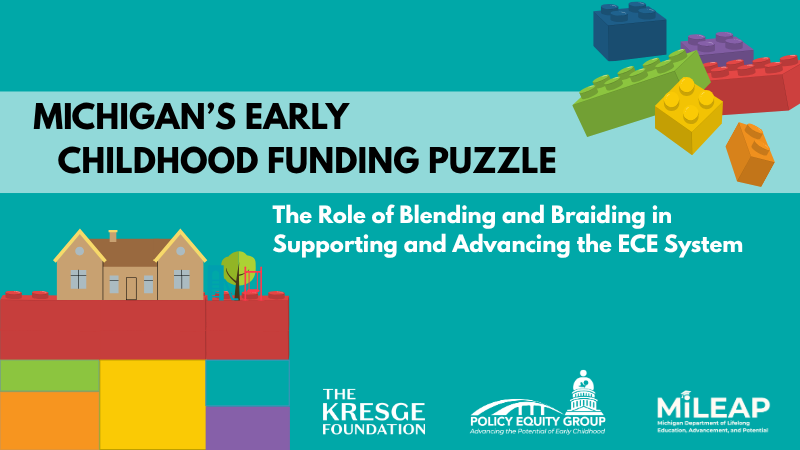
A new report, The Early Childhood Funding Puzzle: The Role of Blending and Braiding in Supporting and Advancing the ECE System, examines how funding from programs including Head Start, the Great Start Readiness Program (GSRP), Child Development and Care (CDC) Scholarships and the Child and Adult Care Food Program (CACFP) comes together at the provider level. By helping programs coordinate resources, blending and braiding funding can support more sustainable early learning environments and help children from families with different incomes access high-quality educational experiences that build a foundation for growth and development. A webinar about the new report will take place from 1-2:30 p.m., Monday, Oct. 26.
“Michigan’s early childhood providers are doing the important work of caring for and educating our youngest learners while navigating multiple funding sources with different requirements,” said Dr. Beverly Walker-Griffea, executive director of the Michigan Department of Lifelong Education, Advancement, and Potential (MiLEAP). “We are committed to listening to providers, reducing unnecessary barriers, and finding ways to make our early childhood investments work better together for children and families.”
Developed by the Policy Equity Group with support from MiLEAP and The Kresge Foundation, the report builds on Michigan’s ongoing work to strengthen coordination across early childhood programs. A related provider guide is also available for child care professionals.
Building on Michigan’s progress
Providers can combine funding streams to support children and program costs. However, because those funding streams were created for different purposes and come with different eligibility, reporting, and spending requirements, making them work together can be complex.
Michigan has already taken steps to reduce that complexity. MiLEAP recently updated GSRP funding guidance to provide greater flexibility for classrooms with multiple program funding and created a GSRP–Head Start blend waiver process to better align requirements across the two programs.
The new report builds on that work by mapping how Michigan’s major early childhood funding streams interact, examining lessons from the Marygrove Early Education Center in Detroit, and identifying additional opportunities to strengthen the system over time.
“Strong early childhood systems depend on funding structures that work for children, families and the providers who serve them,” said Jonathan Hui, senior program officer at The Kresge Foundation. “Integrated funding strategies ensure that high-quality early learning programs can be accessed by all families, regardless of income.”
“Michigan continues to look for ways to strengthen our early childhood system for children, families, and providers,” said Synthia Britton, MiLEAP interim deputy director overseeing the Office of Early Education. “Early childhood providers often operate on tight financial margins, and navigating multiple funding sources can add to the challenge of keeping their programs running. Better coordinated and more predictable funding can help stabilize providers, supporting the consistent, high-quality care and early learning that children and families rely on.”
The report identifies opportunities and recommendations to better align program rules and requirements, strategies that stabilize program funding, and coordinates public investments with the realities of operating early childhood programs. These approaches could help providers make better use of available resources and support a more sustainable system that expands access to high-quality early learning for all families.
“Michigan’s early childhood providers are navigating funding streams that weren’t designed to work together,” said Dr. Kelly Etter, vice president of early childhood equity initiatives at Policy Equity Group. “Blending and braiding can help make the most of today’s resources, while also showing us where we can build a simpler, more equitable and sustainable system.”
MiLEAP, The Kresge Foundation, and Policy Equity Group will discuss the report and its implications during the webinar – Solving the Early Childhood Funding Puzzle: Lessons from Michigan – which will take place from 1-2:30 p.m. on Monday, Oct. 26.
Resources: