



For 110 years, the Citizens Research Council has helped Michiganders make informed decisions through independent, nonpartisan research.
- New podcasts in Con-Con series: Article II-Elections and Article III-General Government
- New Con-Con Brief: Article III, a catch-all section of the Constitution
- Council Brief: Michigan’s Income Tax: Where Does the Money Go?
- Citizens Research Council turns 110! Please Support our April Anniversary Campaign
Before the November Con-Con Vote: Podcasts cover Articles II (Elections) & III (General Government) |
There was a time when Article II – Elections of the state constitution was a mostly ignored section. Not so anymore. In recent years, it has taken center stage. Guy Gordon and Eric Lupher discuss Articles II and III as part of a continuing podcast series examining Michigan’s Constitution, prior to the November ballot question asking whether Michigan should hold a constitutional convention (aka: Con-Con). Lupher explains that Article II has become far more significant and politically charged amid recent debates over voting rights, election security, and direct democracy. They also look at Michigan’s voting rights landscape, which expanded dramatically through the 2018 and 2022 “Promote the Vote” amendments, which added no-cause absentee voting, same-day registration, drop boxes, and other protections. These changes have expanded Section 4 of Article II from 111 words to more than 1,300, making it a likely focal point in any constitutional convention. |
|
They also discuss how Article III – General Government serves as a catch-all for structural or administrative issues, containing provisions that don’t neatly fit into the legislative, executive, or judicial branches. If voters approve holding a constitutional convention, they discuss how issues such as transparency, nondisclosure agreements, and the long-debated prohibition on using public resources for “internal improvements” could be revisited. They also note how a Con-Con could revisit the reference to a “militia,” a historically rooted but outdated term, given the existence of the National Guard and federal requirements governing National Guard units. |
Find all #FactsMatter podcasts on SoundCloud, Apple, Spotify, Amazon or wherever you get your podcasts. LIKE and SUBSCRIBE! |
Article III-General Government: the Sixth Report on Michigan Constitutional Issues |
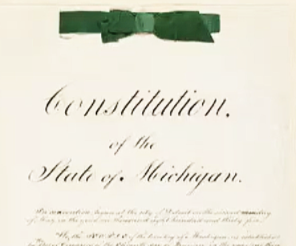
Article III-General Government of the Michigan Constitution covers relatively non-controversial subjects, such as the location of the capital, the establishment of the three branches of state government, the provision for a state militia, and the allowance of intergovernmental agreements. A constitutional convention could revisit the current prohibition on state involvement in internal improvements and the legislature’s ability to seek advisory opinions from the state supreme court on the constitutionality of pending laws. |
Michigan’s Income Tax: Where Does the Money Go? |
|

April 15 was Tax Day. That means hundreds of thousands of Michigan taxpayers were putting the finishing touches on tax returns and sending them in to federal, state, and – for some – even city governments to meet the annual tax deadline. Few of those filers, however, would likely be able to answer this fundamental question: how are governments using these income tax proceeds? In this election year, that question has become especially relevant to Michigan’s individual income tax. Several gubernatorial candidates have pledged to significantly reduce or even completely eliminate the tax, with few, if any, details on how they would replace the lost revenue with new revenue from another tax source or absorb the loss by shrinking specific areas of the state budget. |
IN A NUTSHELL — With the November election drawing near, proposals to significantly reduce or even eliminate the state income tax have become prominent, but few details have been offered on how to either replace that revenue or absorb its loss. — The income tax is the state’s largest single revenue source and makes up roughly 16 percent of the total state budget, but its revenue flows into the state’s two major revenue funds – the General Fund and School Aid Fund – that drive much of the budget decision-making. The tax makes up 40 percent of these discretionary revenues. — Eliminating the income tax without replacement revenue would necessitate major reductions to some or all of the programs that receive the bulk of this discretionary revenue – programs such as Medicaid and human services, corrections, public education, revenue sharing, and state police. |
|

For 110 years, donors like you have made independent, trusted, fact-based policy research possible in Michigan. Your support ensures this work stays accessible and free from political influence.
|
Media Coverage |
Term Limits Won’t Drain the Swamp: They’ll Flood It, The Hartmann Report (April 17) Republican Field Complete; Every Candidate Wants To Eliminate A Major Tax MIRS News (April 15) 13 years later, Detroit looks to close its historic bankruptcy case, Crain’s Detroit Business (April 15) Gambling addiction on the rise. Michigan does less than most states to help, Bridge Michigan (April 13) CRC turns 110-Eric Lupher, WPHM Morning Show (April 13) Spotlight on the News: CRC’s 110th anniversary, WXYZ-7Detroit (April 12) Michigan officials: Tough getting people to seek office, sit on boards, Detroit Free Press (April 11) Citizens Research Council of Michigan marks 110 years of nonpartisan policy work, WZMQ TV19 (April 9) |
Help Power Policy That Works for Michigan |
Our “Fact Tank” fuels better government through trusted, independent research. But it doesn’t run on fumes—it runs on your support. Make your tax-deductible donation today to keep Michigan informed, accountable, and moving forward. Ready to make a lasting impact? Learn more about planned giving today. |