



Livonia, MI, Dec. 4, 2025 – Citizens Research Council of Michigan today released a report analyzing the series of public acts recently passed by the legislature to address funding for Michigan’s roads, collectively referred to as the 2025 transportation funding package (TFP).
The Assessment of the 2025 Michigan Transportation Funding Package provides details on sources of new and newly earmarked revenue, as well as how this funding is likely to be distributed between the Michigan Department of Transportation, county road commissions, and city/village road agencies.
However, the 2025 TFP contains several potential pitfalls and oversights. It is difficult to predict to what extent this legislation will improve Michigan’s statewide road and bridge infrastructure.
Estimated Revenue Impact of 2025 Transportation Funding Package, FY2026 to FY2031
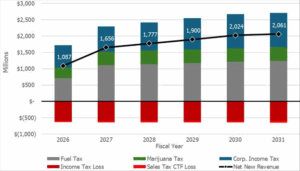
“By replacing the sales tax with an increase in the motor fuel tax rate, the Michigan Transportation Fund will receive a meaningful funding increase that should be dependable for years to come,” said Eric Paul Dennis, PE, research associate for infrastructure and author of the report. “But much of other changes in this package appears haphazard and not well thought-out.
“Policymakers and road agencies will have to wait and see how much revenue from the Marijuana Wholesale Tax and Corporate Income Tax will become available. Even if all anticipated revenue is provided, the uncertainty imposes new difficulties in planning and programming construction projects.”
An analysis of roads funding data from 2013 to 2022 concludes that Michigan ranks 28th nationally, with funding levels similar to peer states like Ohio and Indiana. Michigan is no longer an underfunded state—it is about average.
The 2025 TFP will build on recent funding increases, potentially making Michigan one of the top 15 best funded states. Yet there is uncertainty around how much of the intended new funding will be available and how impactful it will be.
“It is time for Michigan policymakers to establish clear legislative priorities and goals for the state roads program,” stated Dennis. “When rational state transportation policy is established, policymakers should fund independent research to estimate the funding needed to achieve relevant goals. This would provide clear guidance that would allow for long-overdue fundamental reform of Michigan’s roads program. This is the only way to break the cycle of crisis management that has driven Michigan road funding policy for decades.”