


MBN Speaker Series:
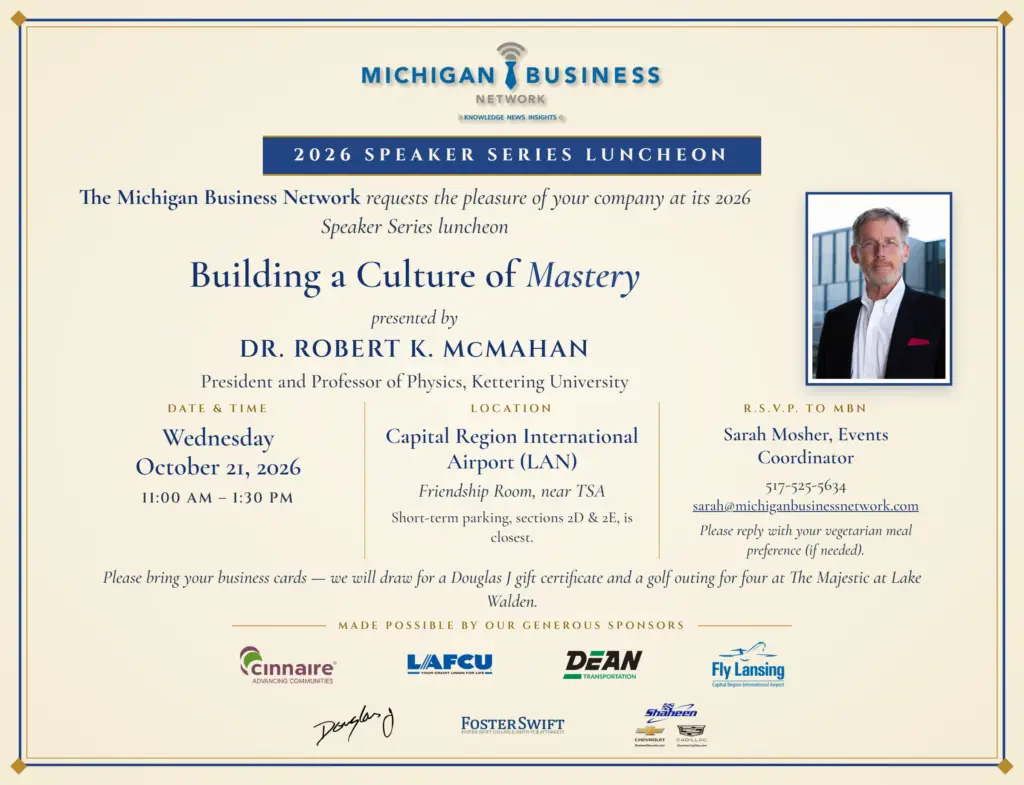
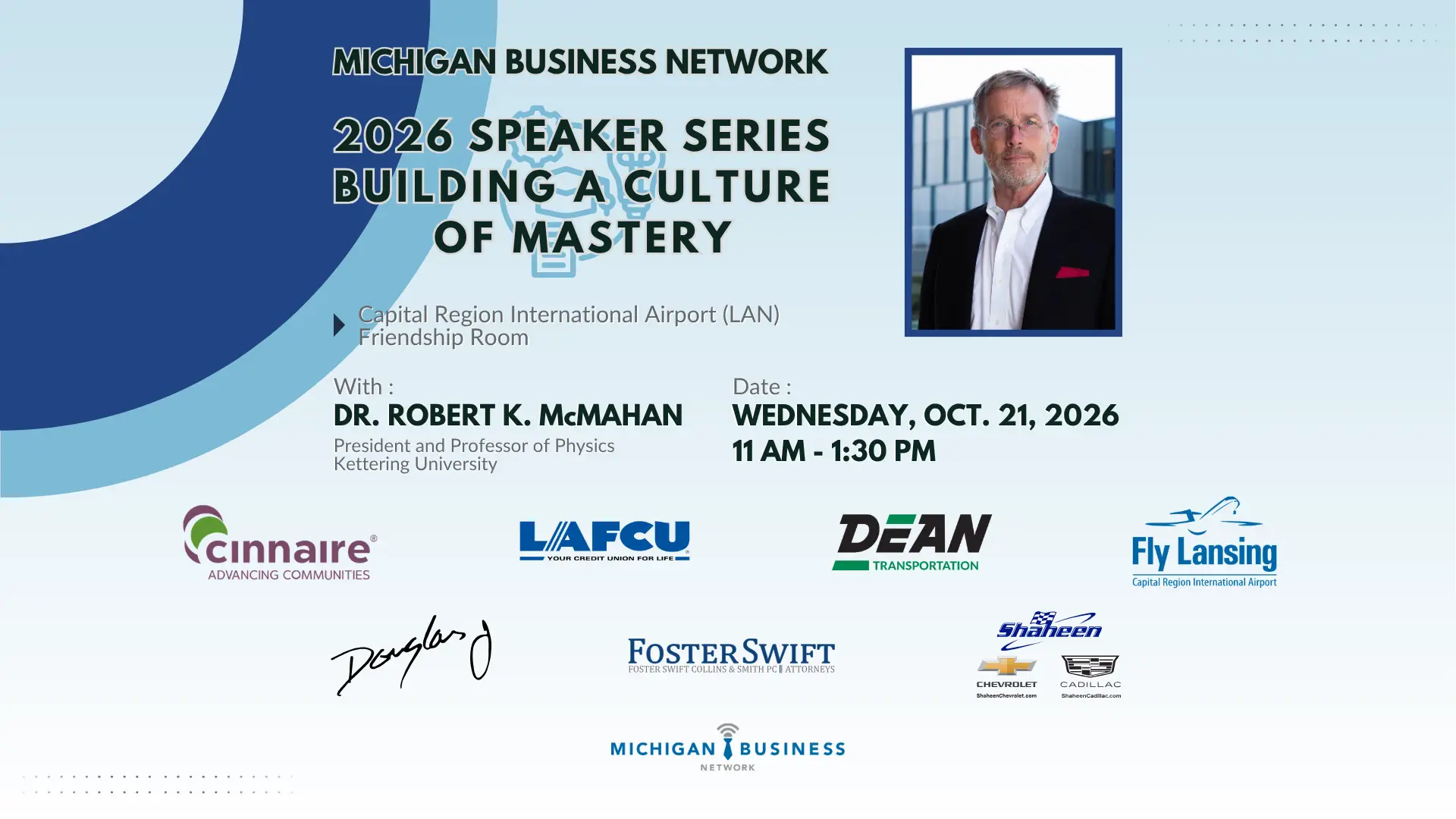
October 2026’s program featured “Building a Culture of Mastery” with guest speaker Dr. Robert K. McMahan , President, and Professor of Physics at Kettering University (above). Watch that day’s program featuring President McMahan’s presentation in the YouTube video shared below:
Kettering University President Dr. Robert K. McMahan’s central message was that organizations must deliberately build mastery—the ability to apply knowledge with sound judgment when circumstances become difficult. As AI takes over tasks traditionally assigned to beginners, he argued, employers and educators can no longer assume that experience and leadership ability will develop naturally.
His presentation, “Building the Culture of Mastery,” was not an argument against AI. It was a call to organize work and education so that people develop the judgment necessary to use powerful tools responsibly—and act when those tools fail.
Experience is a bank account built before a crisis
McMahan opened with Captain Chesley “Sully” Sullenberger’s emergency landing on the Hudson River. He used Sullenberger’s description of making regular deposits of experience, education, and training throughout his career to explain how preparation supports decisive action under pressure.
The lesson: people cannot acquire judgment at the moment they urgently need it. Organizations must create opportunities to develop it beforehand.
He distinguished knowing information from being able to use it:
“Mastery is not what you know. It is what you can do with what you know.”
AI is disrupting the traditional path from beginner to expert
McMahan identified two related challenges.
1. The work that trained beginners is disappearing
Historically, early-career professionals learned through assignments such as preparing first drafts, reviewing documents, conducting basic analyses, and responding to corrections from experienced colleagues.
Those assignments were not simply output to be produced cheaply. They also developed professional judgment.
As generative AI assumes more of that work, McMahan argued, organizations risk removing the first steps in career development. He compared the situation to a tower whose ladder begins halfway up: the desirable jobs remain above, but newcomers lack a way to reach them.
2. Automation can weaken independent capability
Using aviation’s “children of the magenta” analogy, he described the danger of becoming so accustomed to following automated guidance that people lose the ability to operate without it.
His concern was not that organizations use AI. It was that professionals might follow its answers throughout their careers without learning how to recognize when those answers are wrong.
The challenge is to retain human capability while benefiting from automation.
His own aviation experience illustrated the stakes
McMahan recounted a flight during which an autopilot malfunction caused his aircraft to roll and descend while he was flying in clouds.
His recovery depended on an instructor’s earlier teaching: cross-check the instruments, recognize that physical sensations can be misleading, and do not assume the automation is correct.
That experience reinforced the importance of mentorship. Someone else’s instruction, absorbed years earlier, became available when he needed it most.
For employers, his question was essentially: who is preparing your people to respond when your organization’s systems fail?
Kettering’s model builds professional formation into education
McMahan presented Kettering’s cooperative-education structure as an intentional answer to this challenge.
He described students alternating every 12 weeks between academic study and paid professional work, accumulating up to two and a half years of work experience by graduation. Rather than treating an internship as an optional supplement, he said, Kettering organizes its education around the repeated connection between learning and working.
His distinction was that students do not simply complete college and then begin developing professionally. They develop within a career while completing their education.
He illustrated this with a comparison between students who understand AI academically and those who have watched models fail in commercial settings. The difference, he argued, is not necessarily intelligence or theoretical knowledge—it is experience dealing with real consequences.
Four practices for building a culture of mastery
McMahan translated his argument into four recommendations for employers.
| Practice | What it means in the workplace |
|---|---|
| Give beginners consequential work with a safety net | Assign meaningful responsibility early, while keeping experienced people close enough to catch errors before they cause serious harm. |
| Require people to “fly by hand” | Have employees develop an analysis, draft, or approach themselves before relying on automation. Ask how they would recognize an incorrect answer. |
| Treat honest failure as learning | Encourage people to disclose and examine mistakes. Punishing every admission of error can create concealment rather than improvement. |
| Make teaching part of senior employees’ jobs | Evaluate experienced people not only on what they produce, but also on whom they develop and what knowledge they pass along. |
His point was that capability grows through the design of everyday work—not merely through an occasional leadership seminar.
Developing people costs time—but neglecting it costs more
McMahan acknowledged that mentoring takes productive time from an organization’s most experienced employees. That expense is visible in schedules and budgets.
He argued that the alternative carries larger, less visible costs: paying a premium to recruit experienced people developed elsewhere, or encountering a consequential problem that no one is prepared to handle.
Culture, in his framing, is established through repeated leadership decisions:
-
Who receives the difficult assignment?
-
Who is allowed to make a mistake and learn from it?
-
Who is expected to teach?
-
Who is being prepared for greater responsibility?
What the opening Q&A added
In the recorded portion of the questions and answers, McMahan reinforced two themes:
-
AI is becoming embedded across disciplines and business processes. He called it a powerful “force multiplier,” while emphasizing that it must not replace the foundational skills needed to evaluate its output.
-
Kettering’s employer relationships extend beyond General Motors. He described GM as one partner within a network of more than 600 companies spanning multiple industries, including automotive, aviation, pharmaceuticals, medical devices, finance, and AI.
The recording ends with a question about declining college enrollment, particularly among men. It does not include his answer, so no conclusion on that subject can be drawn from this transcript.
Overall takeaway
McMahan challenged business leaders to treat developing people as an operating responsibility, not something they can outsource entirely to colleges, training programs, recruitment, or technology.
His closing message returned to the bank-account metaphor: the difficult moment will belong to the employee who faces it, but leaders are responsible for helping that person build the experience and judgment needed long before it arrives.